

Like many people, I have spent more than 60 years following the documentary series that started with 7 Up and continued every seven years thereafter until last night’s final episode of 70 Up.
Along with almost 1 million Brits, I am the same age as the ten boys and four girls interviewed in the first episode, broadcast when we were seven years old. I was also at school with, and in the same class as, two of the boys (more on that below), which puts me in a slightly smaller group of perhaps several hundred people in terms of contemporary personal knowledge of some of the child participants.1
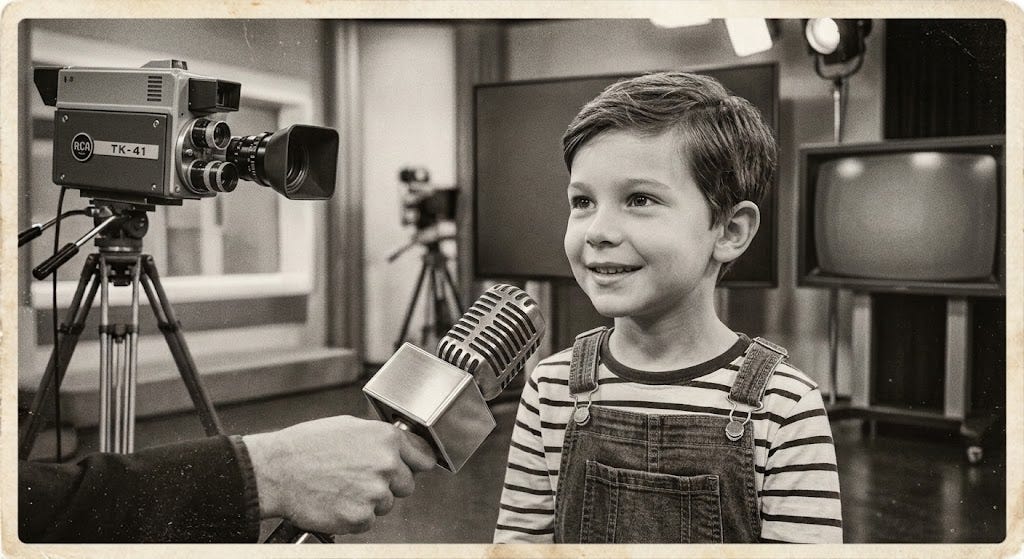
As much as I give the documentary makers top marks for persistence over such a lengthy period, I have long been angered and frustrated by the approach taken and was delighted when, at long last, Michael Apted, the man at the heart of the first nine of the ten episodes, was taken to task for his approach and for the insidious assumptions that he adopted as the framework for the series. Don’t take my word for it: this is Apted himself speaking at the time of 56 Up:
I wanted to make a nasty piece of work about these kids who have it all, and these other kids who have nothing.
The nastiness was manifest in the portrayal of John, Andrew and Charles, whose parents had seemingly mapped out schools and universities to attend – even to the point of deciding which Oxbridge college they should attend. Was this privilege, as the documentary sought to portray? Or was it just parents instilling the importance of education in the minds, and the aspirations, of their children? Note how, even at 7 years old, John knew – and told the camera – that he would need to pass an exam to get into the school chosen for him by his parents.
Certainly, the schools chosen for John, Andrew and Charles were fee-paying choices which would not have been open to all. But were there not parents in 1964 who, without that level of wealth, wanted their children to pass the 11-plus exam in order to attend the State schools which would then be open to them? Of course there were. But none of those parents’ children was selected for the film because it didn’t suit Apted’s plan.
And, of course, once the fourteen had been chosen in 1964, it wasn’t possible to add more at a later date.
Charles stopped appearing from age 21. John opted out of some adult episodes, but he was present last night to tell us how people he met in his professional life had first encountered him through the documentary and expected not to like him, only to come to a different conclusion. I am not at all surprised. He is one of the two I was at school with. In his case, it was between the ages of 8 and 13. We spent many hours on a tennis court together. He was a delightful boy with a lovely sense of humour (albeit always desperately slow to get changed for tennis when I was waiting to get going).
The original “class” story was gently disguised by couching it in terms of the Jesuit saying:
Give me a child until he is 7 and I will show you the man.
The phrase was repeated endlessly throughout the documentaries, but never seriously tested. What did people expect the adults to be when they looked at the seven-year-olds? How did the actual adults compare at the different ages? It was never examined. The closest the film-makers got was in the final episode when several of the 70-year-olds were asked whether they recognised their seven-year-old selves as predictors of how they turned out. That’s an interesting question, but a very different one.
And what about the parents? If the hypothesis was that their wealth was an influence on the children, how much did parental attitudes pass down to the seven-year-olds? And how much of that influence endured as adulthood took over? We saw nothing of that.
We were told only about fathers who were absent: Symon never met his father or knew who he was, whilst Bruce was already separated from his by the time he was seven. Both these facts were referred to repeatedly over the decades. It turned Bruce’s story into something of a heartbreaker. It was decades before any of the films mentioned, only briefly, that John’s father died not long after 7 Up. It certainly wasn’t mentioned during the final retrospective of 70 Up.
Bruce was the second participant that I was at school with. You wouldn’t know it from the TV series, but between the ages of eight and thirteen, Bruce and John were at the same school and in the same class as each other (together with me and some 20 other boys).
But perhaps the biggest questions – for every viewer, I suspect, and not just for me – revolve around Neil. From a lively, cheerful and very articulate schoolboy, he was transformed by the age of 21 into a young man shorn of ambition. By 28, he was in desperate straits. Riven with anxiety, he has since been, at times, jobless and homeless, at other times a local councillor or a lay preacher, but never in any one role or one place for very long.
In 70 Up, this was attributed to a lifetime of depression. Maybe. But many deeply depressed people fare better than that. Given the friends that we learned he had along the way, not to mention the involvement of an ITV reality TV team every seven years, what help was he offered? What help did he accept? Perhaps Neil declined to answer. Or perhaps he answered on condition that it was treated in confidence. That is his choice, of course. But I was left with the impression that it wasn’t asked, which made the documentary team look bad, even if it is not the case.
There was so much else that wasn’t asked. And so much that was that shouldn’t have been.
I was also in the back of Tony’s cab some decades ago. Is there anyone in London who hasn’t been?