

Some thirty years ago, I observed leading counsel make closing arguments in the High Court. He commented that six times he had asked a particular witness a question and six times the witness (who was also my client) had avoided answering. Counsel said the implication was clear and he invited the judge to conclude that the unspoken answer was unfavourable to my client’s case.1
I was reminded of that this week as I watched Prime Minister’s Questions. Six times, Kemi Badenoch, Leader of the Opposition, asked the Prime Minister, Keir Starmer, about his conversation with Peter Mandelson before appointing Mandelson as Ambassador to the United States and six times Starmer directed his answer to a completely different topic.
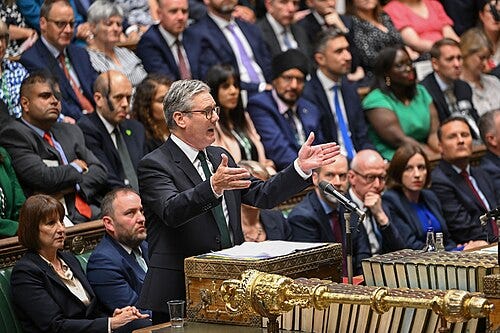
We have grown used to seeing a Prime Minister skilfully ducking a question. But this wasn’t at all skilful. I don’t recall ever seeing something as blatant as this swerve from a question about Mandelson to an answer about the right of Muslims to pray in public.2
The question itself – like most questions from the opposition benches – was designed to embarrass the Prime Minister, rather than to elicit information (“Why did the Prime Minister believe Peter Mandelson [rather than] the vetting documents?”).
And therein, I wonder, lies the problem with modern politics? Have politicians lost the ability to debate a way to resolve today’s challenges – of which Britain has more than its fair share – because every exchange between politicians is driven by appearance, not by substance?
This is not just a criticism of the political class. The press encourages this behaviour. Despite being well-staffed with intelligent journalists who are more than capable of challenging politicians, their questions are, all too often, designed to make politicians look bad, rather than delve properly into their views. I have written before (including specific examples) about the choice of so many interviewers to pose questions designed to belittle the politician in front of them, rather than to test their ideas.
This has consequences. If all politicians look bad, how can the public choose between them? Is it not the case that the current environment is positively increasing the chances that charlatans like Boris Johnson – people who are practised at deception – rise to the fore because they can fake honesty on the way up – only to be found out when it is too late?
Sadly, those who have spent a lifetime being honest almost certainly find that today’s political environment does not allow them to continue in that way. I don’t know enough about Keir Starmer’s previous history to know whether he properly falls within that category, but there is a pretty good chance that, as a former Director of Public Prosecutions, he does. The public (and I) certainly expected it of him. And yet, as a politician, it seems pretty clear that he will promise whatever he thinks will get him elected and then pursue whatever (different) policies he thinks will enable him to survive in post.
His government’s tax policy is driven by finding as many groups as possible who can plausibly be inserted into the following statement:
“It’s only right that we’ve had to ask [insert group here] to pay their fair share of tax.”
So, for example, farmers and high-wealth individuals have been targeted for more tax, because they (apparently) have the money with which to pay it.
Maybe the targeted groups do have the money to pay. But, without any attention to the consequences in terms of behaviour in the face of those taxes, increasing the tax is (to borrow a phrase) “all fur coat and no knickers”.
This is an article about appearance, not fiscal economics, so I won’t argue the financial merits here. But I have written before about the consequences in the case of farmers. And others have written about the consequences in the case of high-wealth individuals who have left the UK, not only depriving the government of the expected tax income, but also depriving the economy of the huge amounts that the individuals were spending when they lived here.3
My thesis is about today’s politics, not about Labour or Starmer, in particular, so I must focus on others as well. Look at Kemi Badenoch, who was widely seen as failing in her role as Leader of the Opposition until she changed tack at Prime Minister’s Questions and started focusing on the appearance of her performance, not its content. She now seems safe in her job, at the expense of “the truth even when it is difficult to hear.”
Look also at the debate on assisted dying – a topic that isn’t party political and which deserves a proper discussion. Those who are opposed often claim to be motivated by a strong moral belief. And I do not doubt that many – perhaps almost all – truly are. The MP who led the opposition in the House of Commons, Danny Kruger, frequently speaks of his Christian values (for example, here and here). But that didn’t stop him uttering one untruth after another when speaking about the bill to Newsnight, including assertions that:
“the bill allows government officials to conclude that some people would be better off dead” (false);
“doctors don’t [currently] decide to kill people” (falsely implying that the bill would allow doctors to make that decision);
“palliative care would be denuded of support” (ridiculous);
“we would be saying that some people have a new human right” (a legal fiction); and
“anyone who is frail, disabled or near the end of life would be obliged to have a conversation” (completely untrue).
It would be naïve to expect all those who pursue power to speak the truth, the whole truth and nothing but the truth. But if even those who come into politics from the courts or the church cannot have a proper debate for fear of losing votes, somebody needs to remind me why we love democracy so much.
At this distance of time, I don’t recall what (if anything) the judge made of that particular point, but my client was wholly successful in defending the claim.
The preamble to Badenoch’s question starts here. It contains nothing about prayer rights. Starmer had raised that issue in a previous answer, which was equally unrelated to the question put to him on that occasion.
I have also written about the foolishness in thinking that taxing non-domiciles is so obviously fair and reasonable.
I think I need to explain that the earlier comment isn't by me. It's from someone with whom I share a name!
Thank you, very interesting.